
A town hall with history
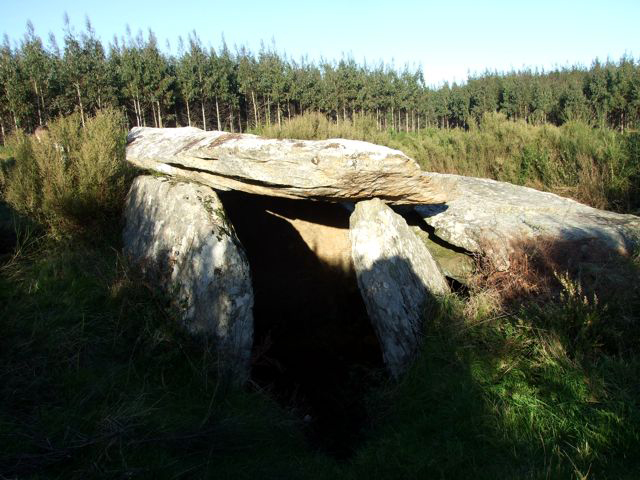
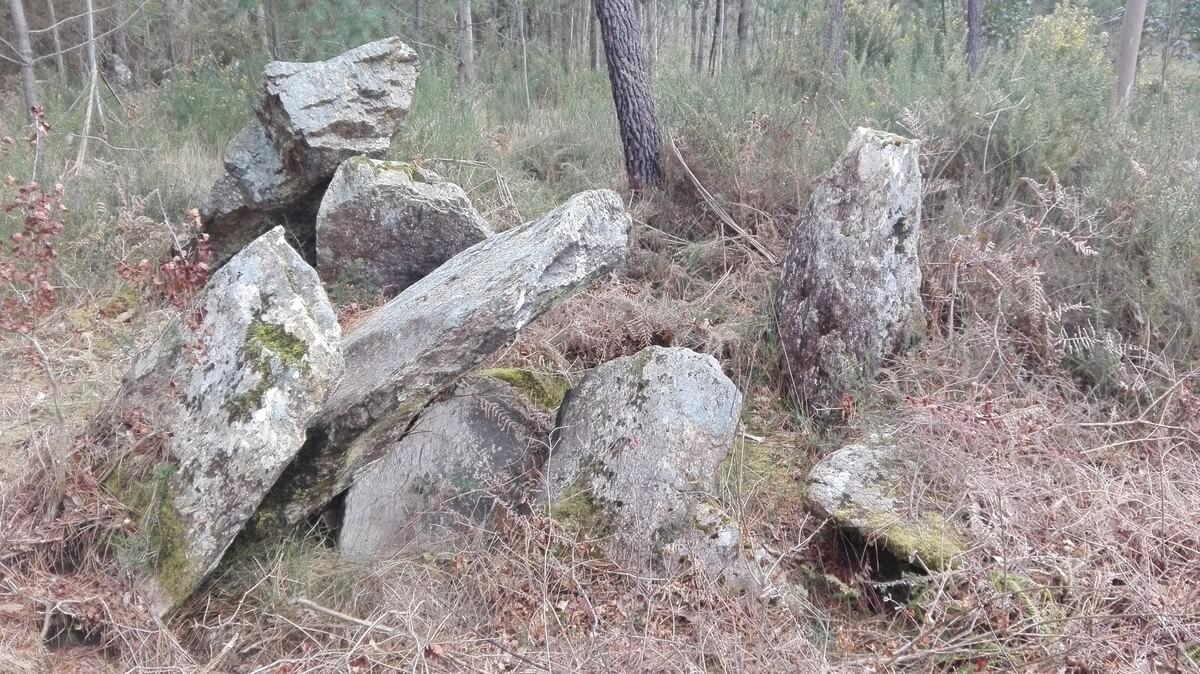
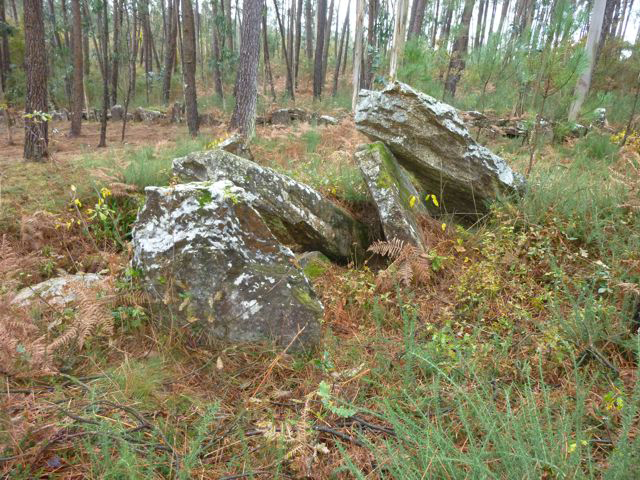
Zas preserves traces of all eras: from the abundance of mamoas and antas – with the Arca da Piosa (Muíño) as a well-preserved reference – to the Castro culture, represented by the enclosure of Santo Adrián de Castro, located on a hill with a classical typology. Romanization, although late, was intense in Brandomil, where a Romanized fort, remains of a roadway, a medieval bridge on Roman bases and numerous inscriptions that reveal the presence of population from outside Gallaecia are documented, all after the second century A.D. The Germanic stage left a deep toponymic mark (Gomariz, Gontalde, Vilar Ramilo) and it has even been proposed that “Zas” is an ultra-correction of “Salas”, It originated in the Germanic salt. As a medieval symbol, the bridge of Brandomil stands out, the main historical monument of the municipality and testimony of its road continuity since Antiquity.
Zas on the Mariana Way
The Luso-Galician Marian Way is a pilgrimage route that connects the sanctuaries of Nossa Senhora do Sameiro, in Braga, and Nosa Señora da Barca, in Muxía, along about 400 km that combine nature, heritage and spirituality. In its stretch through the Municipality of Zas, the Camino follows the trail of ancient devotional itineraries and shares stretches with the Camino to Fisterra-Muxía, consolidating itself as a less crowded pilgrimage alternative but full of symbolism.
In Zas, the Via Mariana runs through the parishes of Brandomil and Brandoñas, two enclaves marked by rural tranquility and a very outstanding heritage. In Brandomil, the pilgrim can approach the surroundings of the bridge of Roman origin and the Xallas river, while in Brandoñas the path passes by the church of Santa María and the tourist camp, making this area a perfect place to take a break, rest and enjoy the landscape. The sum of these elements makes the passage of the Via Mariana through Zas a serene, authentic experience and closely linked to the identity of the interior Costa da Morte.
![Parte dunha columna romana usada para subir a un horreo [Foto EDR]](https://concellodezas.gal/wp-content/uploads/2021/05/Parte_dunha_columna_romana_usada_para_subir_a_un_horreo_Foto_EDR.jpg)
![Miliario romano ou fuste dunha columna. Private Garden [Foto EDR]](https://concellodezas.gal/wp-content/uploads/2021/05/Miliario_romano__ou_fuste_dunha_columna._Xardin_particular_Foto_EDR.jpg)
![1Ara romana dedicada a deusa Fortuna exposta nun xardin particular de Brandomil [Foto EDR]](https://concellodezas.gal/wp-content/uploads/2021/05/1Ara_romana_dedicada_a_deusa_Fortuna_exposta_nun_xardin__particular_de_Brandomil_Foto_EDR.jpg)

![Pozo Limideiro. Ancient gold mining probably already of the Roman period[Foto EDR]](https://concellodezas.gal/wp-content/uploads/2021/05/Pozo_Limideiro._Antiga_explotacion_aurifera_probablemente_xa_de_epoca_romana_Foto_EDR.jpg)
The municipal history of the City Council of Zas
The municipal minutes are the administrative memory of the City Council: they collect agreements, expenses, works, elections and incidents of local life. In Zas, the minutes begin in 1852 and have gaps in some periods (e.g., 1853–1854; 1856–1877; 1896…), something common until there was a stable Town Hall in 1951. They are, therefore, an “official” vision and sometimes biased by the municipal power, but essential to reconstruct our history. Below we show you some of the most remarkable milestones of each era. Later, you can see and download the PDFs of the municipal minutes that describe the municipal history of the City Council of Zas.
Birth of the City Council of Zas
First minutes and standard
The arrival of Manuel Montero as mayor
Road and bridge of Lodoso in Baio
Portuguese roads and sawmills
The Age of the Automobile
The Big Flu
The Diaspora Organizes in Buenos Aires
Passion for football: Zas vs Soneira
The Republic and the School of Fornelos
Military camp in Cacharosa
New City Hall
Agra Regueiro Schools in Baio
Lighting, mechanization and damming
The LGE and the regional schools
Political change: Cortizo mayor
Supreme Court ruling and telephony
The history of the City Council of Zas, according to the municipal minutes
Like the vast majority of other Spanish municipalities, Zas was formed in 1836, but little can be known about its first 16 years of existence, from 1836 to 1852, due to the fact that either the municipal records of these years were not made or preserved. Nor do we know the name of the mayors who followed the first, Antonio Fernández, a name that we know from a document in the 2nd Book of Fábrica de Zas-Vilar 1798-1868 (Lema Suárez 1993-III: 540).
By 1852 there were municipal records. In this way, we will try this year to give a historical view of what has happened in the official life of the municipality up to the present day. It will not be a complete history, for reasons that we will point out and also because, in addition to the first 16 years, the minutes of the following periods are also missing: from the years 1853 and 1854, from 18.12.1856 to 21.9.1877, from 30.12.1883 to 1.7.1885, from 1896, from 27.12.1898 to 30.7.1901, and from 21.3.1931 to 4.2.1933. These “absences” are partly explainable if we take into account that the City Hall will not be fixed until 1951, and the municipal offices temporarily “traveled” to the house or to the parish that suited the mayor or, what could be even more important, to the house of the municipal secretary.
We will try to make this official history of ours enjoyable by using curious anecdotes – copied to the letter in many cases, and respecting the particular orthography of the Castilian of each era that, in some way, should enlighten us about the domestic concerns and political disputes of times gone by or still recent.
To make it easier to read, we have divided the information provided by the municipal minutes into three sections:
- Interesting Stories and Interesting Anecdotes.
- Evolution of Budgets and Salaries.
- The Never-Ending History of the Construction of the Town Hall.
It should be noted that the information referring to communications, health, education and culture has already been included in its corresponding sections.
The History of Zas from 1836 to 1900
Between 1836 and the end of the nineteenth century, the City Council of Zas emerged as its own administration and the first basic services were organized: standards, archives and minor works. It is a time of territorial definition and balance between parishes, with roads that are improving step by step and an economy that is still very agricultural. Local politics coexists with tensions between sides and the weight of influential families, while society faces health and fiscal crises typical of the time. This period lays the institutional and material foundations of contemporary Zas.
The History of Zas from 1900 to 1931
The new century brought more mobility and social changes: roads were fixed, connections such as Baio-Fornelos were prioritized, and car lines revolutionized regional communications. Economic life was dynamized (wood, small businesses), but the impact of the 1918 flu and emigration was also felt, which articulated new networks with the diaspora. Associationism abroad and growing literacy open up cultural horizons. At the gates of the Second Republic, Zas arrives with more services, more transit and a more connected citizenry.
The history of Zas from 1931 to 1939
With the proclamation of the Second Republic, the municipality experienced a stage of reforms and modernizing hope: schooling advanced, public spaces were improved and political debate was renewed. Educational and civic initiatives coexist with an increasingly tense state context. From 1936 onwards, the war abruptly cut off many of these processes and imposed a new order. The period closes between interruptions, institutional changes, and deep social wounds.
The history of Zas from 1939 to 1978
The dictatorship brought political centralization, but also a gradual boost to public works: new municipal infrastructures, improvements in electricity and water, mechanization of agriculture and educational equipment. From the 50s and 60s, the territory has been modernizing services and connectivity, even with inequalities between parishes and a rural area in transformation. The General Education Act of 1970 strengthens the school network and accessibility to studies. Around 1978, between historic labor rulings and the demand for better communications, the municipality entered the democratic stage with a more articulated local fabric and better material bases.
Zas Retail
From the City Council of Zas we would like to thank the authors of the book “Zas polo Miúdo”, Evaristo Domínguez and Xosé María Lema, since a large part of the texts of their great work have been used to make this website. Thank you very much from the bottom of my heart.