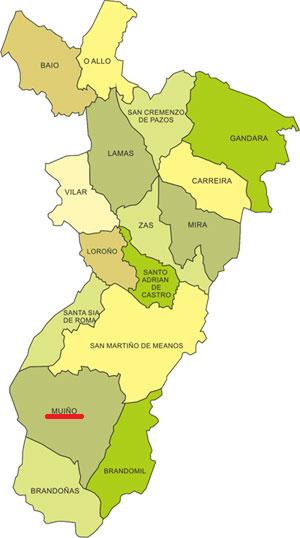
San Tirso de Muíño, a parish whose toponym comes from the Latin molinum ‘mill’, is made up of the following villages: As Abellas, Campos, O Couto, A Churía, A Fonte Espiño, Marán, Pedra Padreiro, A Piosa, A Santa, A Toxa and O Vilar, and it had 263 inhabitants in 2016. Its highest point is the hill of the chapel of Saint Margaret (Santa Margarida), at 346 m above sea level.
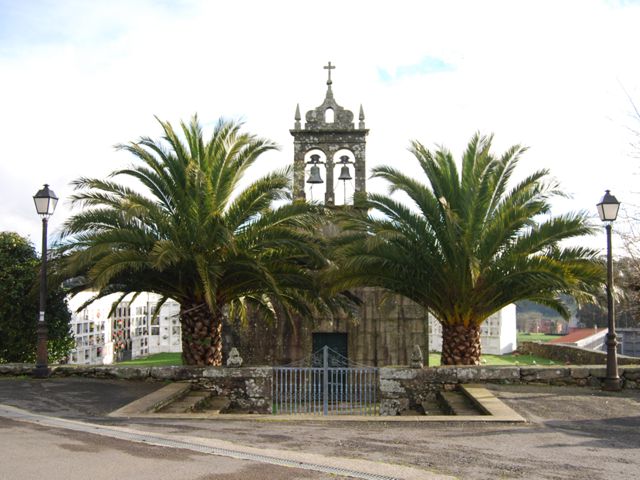
The parish church of San Tirso de Muíño has the classic pentagonal façade, plain and built in ashlar stone, topped in the central section by a simple bell-gable (espadana) that was probably built in the 19th century. However, the rest of the building follows the architectural features of the 18th century and inside there is an elegant stone coat of arms, quartered in a cross and carved from a single block, crowned by a facing helmet. In the quarters you can see the arms of the Pazos, Figueroa and Moscoso families.
The chapel of Saint Margaret (Santa Margarida) dates from the mid-18th century and its altarpiece is neoclassical in style (late 18th – early 19th century), although this shrine already existed before the 18th century: it is said that there was already a pilgrimage here around 1670.
It is also worth highlighting the remains in this parish of what was once the Torre do Couto or Torre de Muíño, residence of the noble Ozores lineage, former lords of the couto of Muíño.
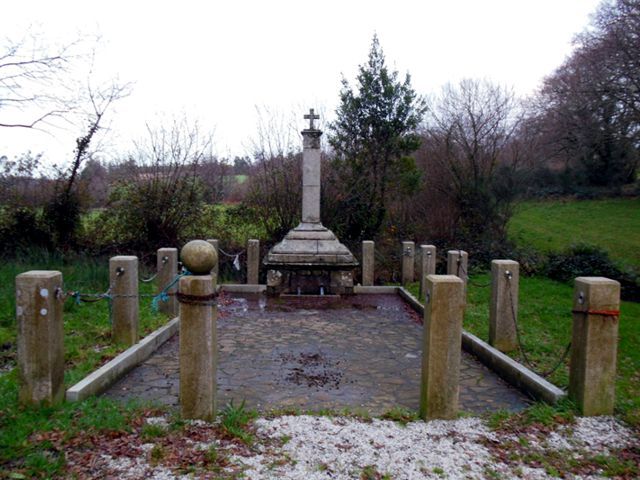
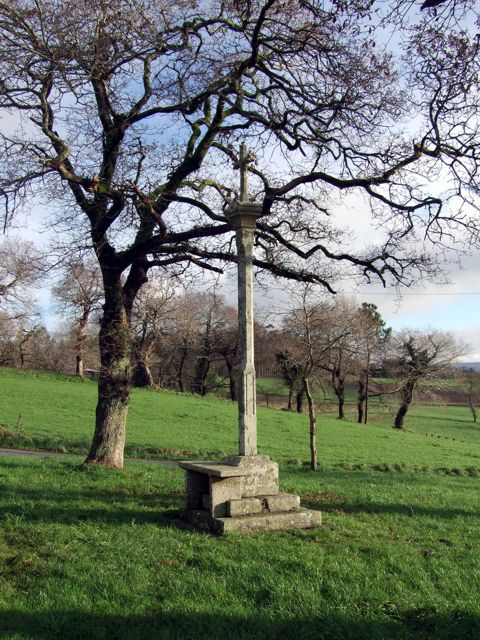
The wayside cross known as the cruceiro do Couto stands out because it is located inside an oval landscaped roundabout, well protected by an iron fence and, although its figures are very eroded, it is considered to be a Baroque work from the 18th century.
The Arca da Piosa is another of the best-known megalithic monuments in all Galicia, belonging to the Soneira–Xallas area, together with such renowned examples as the dolmens of Dombate, Pedra Cuberta, Pedra da Arca de Regoelle, Mina da Parxubeira, etc. It was already known at the end of the 19th century by our historians and archaeologists.